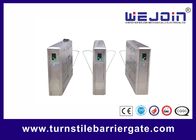
New Challenges in Office Building Access Systems
As office buildings and corporate campuses continue to experience higher occupant density, the stability of entrance access systems has become a growing concern for property managers and system integrators. During peak hours, issues such as inconsistent opening cycles, delayed gate response, and unintended gate movements can directly disrupt pedestrian flow and on-site order.
In practice, access efficiency depends not only on credential technologies such as cards or facial recognition, but also on the drive mechanism and control logic of the swing gate itself. Under high-frequency operation, traditional motor-driven solutions may struggle to maintain consistent performance.
Common Pain Points in High-Traffic Office Entrances
Typical office entrance environments impose several operational demands on swing gate systems:
-
Continuous high-frequency operation during peak entry and exit periods
-
Consistent opening and closing behavior to prevent congestion
-
Reliable interaction with access control systems after authentication
-
Reduced need for manual intervention caused by misalignment or faults
These factors place increasing emphasis on the stability and controllability of the gate drive system.
Technical Characteristics of Servo-Controlled Swing Gates
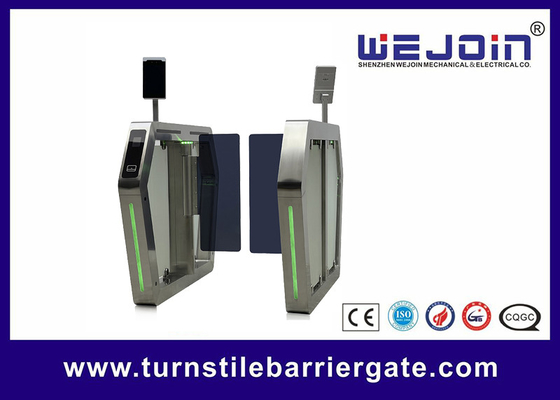
Servo-controlled swing gates have gained attention in recent years due to improvements in motion control precision and system consistency.
Controlled and Adjustable Gate Movement
By using closed-loop servo control, opening speed and swing angles can be precisely managed. This allows the gate to adapt more smoothly to varying pedestrian flow rates commonly found in office buildings.
Design for High-Frequency Operation
Servo swing gates are typically built with DC servo motors and reinforced transmission components. Control logic is designed to limit abnormal external force, helping to reduce mechanical stress during repeated operation.
Clear Integration Logic with Access Systems
In real deployments, swing gates must communicate with access controllers and emergency systems. Support for standard communication interfaces simplifies system integration and helps reduce commissioning time.
Selection Trends for Office Building Swing Gates
From an industry perspective, swing gate selection for office buildings is shifting from basic functionality toward long-term operational stability. Increasingly, decision-makers are evaluating:
-
Whether the drive system is suitable for sustained high-frequency use
-
Consistency of gate response under varying pedestrian loads
-
Environmental operating ranges appropriate for indoor applications
-
Availability of clearly defined technical parameters and limits
These considerations are contributing to the broader adoption of servo-controlled swing gates in office building access control systems.


 Your message must be between 20-3,000 characters!